
Turbofan engine
Also known as the “turbofan engine”, it is developed from a turbojet engine, with a fan and a low-pressure turbine added to the core engine.
The fan rotates to compress the air, and the compressed air is divided into two streams. The outer stream flows in parallel and is directly discharged through the nozzle to generate thrust; the inner stream is the same as an ordinary jet engine, and is discharged from the nozzle after passing through the compressor, combustion chamber and turbine.
The ratio of the flow rate of the outer stream to the inner stream is called the bypass ratio or flow ratio. Under the same core engine conditions, the turbofan engine has a large total air flow and a low exhaust velocity, so compared with the turbojet engine, it has greater thrust, higher propulsion efficiency and lower fuel consumption.
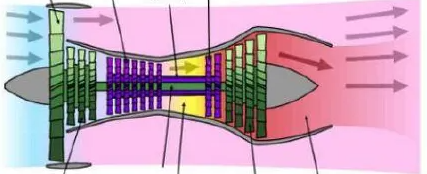
After the 1970s and 1980s, turbofan engines developed rapidly and began to replace turbojet engines as the main power for military and civilian aircraft. They developed in two directions: military afterburner engines with small bypass ratios and military and civilian engines with large bypass ratios.
The low bypass ratio afterburning turbofan engine has the characteristics of low fuel consumption in subsonic cruise and supersonic maneuverability, and is suitable for combat maneuvers;
The high bypass ratio engine has the characteristics of low fuel consumption and low noise, and is usually widely used in large civil passenger aircraft and military and civilian transport aircraft.
Turbojet engine
Also known as a “turbojet engine”, it is generally composed of an intake device, a compressor, a combustion chamber, a turbine, and a nozzle. The compressor, combustion chamber, and turbine constitute the core of the engine.
The main processes of a turbojet engine are all completed in the core engine, including air compression, combustion, and turbine work. After the air enters the engine through the intake duct, it first passes through the compressor, and then enters the combustion chamber after being pressurized. It is mixed with fuel, ignited, and burned to form high-temperature gas. The high-temperature gas expands to drive the turbine to work, and the gas after passing through the turbine is discharged through the nozzle to generate thrust.
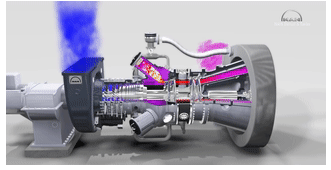
Turbojet engines have brought aviation into the supersonic era, but when turbojet engines generate thrust, they eject gas at high speed. After the high-speed and high-temperature gas is ejected from the engine, it directly dissipates and causes huge energy losses. Therefore, turbojet engines have poor economy and high fuel consumption.
Turboshaft engine
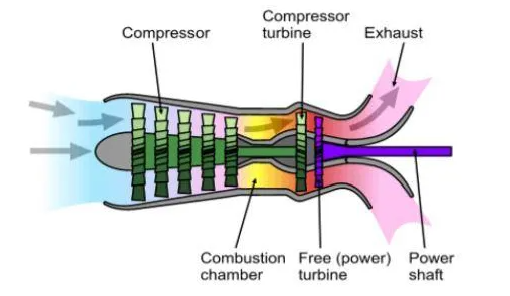
Also known as the “turboshaft engine”, it is the main power of helicopters. Its working principle is similar to that of turboprop engines. After the gas flows through the turbine that drives the compressor, it flows through a free turbine that drives the reducer, and finally sprays out from the tail nozzle. The output shaft of the reducer is connected to the main reducer that drives the helicopter rotor to drive the rotation of the rotor.
Turboshaft engines have the characteristics of high power-to-weight ratio and low fuel consumption. At present, the third-generation turboshaft engines are widely used in the helicopter market, and only a few helicopters use the fourth-generation turboshaft engines.
 Japanese
  English
  Arabic
  Moroccan Arabic
  Dutch
Dutch  French
  German
  Italian
  Polish
  Portuguese
  Russian
  Spanish
  Turkish
  Azerbaijani
  Indonesian
  Thai
Thai  Korean
  Malay
Malay  Myanmar
  Serbian
  Swedish
  Vietnamese