
Môi trường hoạt động của các bộ phận thuộc phần nóng của động cơ máy bay trên tàu và tuabin khí là vô cùng khắc nghiệt. Ngoài việc phải chịu đựng nhiệt độ, áp suất và tốc độ quay cao, các bộ phận này còn phải đối mặt với tác động ăn mòn từ môi trường biển, vốn có độ mặn và độ ẩm cao.
Turbine rotor components represent the most critically stressed elements within these engines and turbines. These parts must bear significant alternating loads at temperatures ranging from 600 to 1300°C while also being subjected to thermal corrosion from hot exhaust gases and the marine atmosphere, which significantly increases their damage rate. As a result, turbine rotor components are among the highest failure-rate operational parts.
As shown in Figure 1, turbine blades undergo thermal corrosion-fatigue failure in the coupled environment of hot exhaust gases and marine air, under conditions of high temperature and high-speed loading. Unlike fatigue failure induced by singular mechanical loads, the mechanism of thermal corrosion-fatigue failure in the hot sections of aviation engines and gas turbines is far more intricate, thus presenting greater challenges for predicting thermal corrosion-fatigue life. To date, there has been some initial understanding both domestically and internationally regarding the mechanisms of thermal corrosion-fatigue failure in these hot sections. Research has been carried out on the mechanisms of thermal corrosion for hot-section materials, thermal corrosion-fatigue failure mechanisms, and thermal corrosion-fatigue life prediction, achieving some preliminary results.

Cơ chế ăn mòn do nhiệt của các vật liệu cấu thành bộ phận đầu nóng
Nickel based superalloys have become the main materials for hot end components such as aircraft engines and gas turbine blades, đĩa tuabin, v.v. nhờ khả năng chống mỏi, chống biến dạng chậm và độ bền tuyệt vời ở nhiệt độ cao [7,8,9] [10,11,12]. Đồng thời, để giảm nhiệt độ bề mặt của cánh tuabin và nâng cao khả năng chống oxy hóa/ăn mòn, các lớp phủ kim loại hoặc lớp phủ rào cản nhiệt (TBC) thường được phun lên bề mặt cánh tuabin [13,14]. Trong quá trình vận hành động cơ, tạp chất S trong nhiên liệu sẽ tạo ra các hợp chất sunfua như SO₂ và SO₃ trong quá trình đốt cháy. Sau khi phản ứng với NaCl trong môi trường khí quyển ven biển, một lớp màng muối nóng chảy Na₂SO₄ sẽ lắng đọng trên bề mặt hợp kim. Các cặn sunfat và các cặn khác hình thành sẽ gây ra hiện tượng ăn mòn nhiệt đối với lớp phủ và hợp kim chịu nhiệt độ cao, cuối cùng dẫn đến hỏng hóc sớm của các bộ phận phần nóng của động cơ.
Hai lĩnh vực kiến thức về máy móc và các công nghệ then chốt!
- Sự ăn mòn nóng của hợp kim nhiệt độ cao là hiện tượng trong đó các cặn sunfat và các cặn khác bám trên bề mặt hợp kim làm hỏng lớp oxit bề mặt và đẩy nhanh quá trình ăn mòn của hợp kim [17]. Đối với hợp kim nhiệt độ cao, mức độ hư hại do sự ăn mòn nóng gây ra nghiêm trọng hơn nhiều so với hư hại do quá trình oxy hóa đơn thuần ở nhiệt độ cao. Mức độ nghiêm trọng của hiện tượng này bị ảnh hưởng bởi nhiều yếu tố, bao gồm nhiệt độ, loại và hàm lượng muối lắng đọng, điều kiện môi trường, thành phần khí và thành phần hợp kim. Tùy theo nhiệt độ môi trường, ăn mòn nhiệt có thể được chia thành ăn mòn nhiệt ở nhiệt độ thấp và ăn mòn nhiệt ở nhiệt độ cao [18]. Ăn mòn nóng ở nhiệt độ thấp (560–815 ℃) thường xảy ra dưới điểm nóng chảy của muối ăn mòn, với điều kiện tiên quyết là phải có áp suất riêng phần cao hơn của SO₃ ở pha khí để phản ứng với các nguyên tố hợp kim trong lớp phủ hoặc vật liệu nền, từ đó hình thành các sunfat mới. Các sunfat này phản ứng với Na₂SO₄ để tạo thành các hợp chất eutectic có điểm nóng chảy thấp (điểm nóng chảy là 540 ℃), gây ra hiện tượng ăn mòn rỗ cục bộ trên hợp kim.
- Sự ăn mòn do nhiệt độ cao (815–980 ℃) thường xảy ra ở nhiệt độ cao hơn điểm nóng chảy của muối ăn mòn. Các muối kim loại kiềm nóng chảy bám vào bề mặt vật liệu nền, dần dần làm hỏng lớp oxit và tiêu hao Cr trong kim loại nền. Khi hàm lượng Cr cạn kiệt, tốc độ oxy hóa tăng nhanh, và các lỗ rỗng nhỏ bắt đầu hình thành bên trong lớp phủ hoặc vật liệu nền, tạo thành các kênh cho môi trường ăn mòn xâm nhập.
- Tại thời điểm này, muối lắng đọng ở trạng thái nóng chảy gây ra sự ăn mòn đồng đều của hợp kim, và giao diện giữa lớp oxit ăn mòn nhiệt độ cao và nền hợp kim tương đối phẳng, với sự hình thành sunfua rõ rệt bên dưới giao diện. Rapp [19] và Singh cùng các cộng sự [20] đã tổng hợp cơ chế ăn mòn nhiệt của các vật liệu kim loại, đặc biệt là các hợp kim nhiệt độ cao gốc sắt và gốc niken, vào đầu thế kỷ 21. Do đó, bài báo này chủ yếu tổng quan về cơ chế ăn mòn nhiệt của các hợp kim và lớp phủ chịu nhiệt độ cao cho đĩa tuabin và cánh tuabin trong 20 năm qua.
Cơ chế ăn mòn ở nhiệt độ cao của lớp phủ
Theo các điều kiện vận hành cụ thể và nhiệt độ mặt trước tuabin của động cơ máy bay và tuabin khí, các lớp phủ thường được sử dụng bao gồm lớp phủ thấm nhôm [21] (chẳng hạn như lớp phủ thấm nhôm trên bề mặt cánh tuabin và khoang bên trong, lớp phủ thấm nhôm-silic), lớp phủ MCrAlY [22] và lớp phủ rào cản nhiệt [23]. Lớp phủ rào cản nhiệt điển hình cho các cánh tuabin hợp kim chịu nhiệt cao thường bao gồm một lớp liên kết kim loại và một lớp gốm cách nhiệt, cung cấp các lớp cách nhiệt và chống oxy hóa giữa chất nền cánh tuabin hợp kim chịu nhiệt cao và khí nhiệt độ cao, từ đó đảm bảo hoạt động an toàn của cánh tuabin ở nhiệt độ mặt trước tuabin cao hơn. Lớp liên kết kim loại có thể cải thiện độ bám dính giữa hợp kim nền và lớp gốm bề mặt. Trong quá trình hoạt động ở nhiệt độ cao, lớp này cũng có thể hình thành một lớp oxit phát triển nhiệt (TGO) dày đặc, đóng vai trò chống lại quá trình oxy hóa ở nhiệt độ cao. Các vật liệu TBC thường được sử dụng hiện nay bao gồm ZrO₂ được ổn định bằng Y₂O₃ (YSZ, tỷ lệ khối lượng Y₂O₃ thường từ 7% đến 8%), mullite, Al₂O₃, YSZ+CeO₂, La₂Zr₂O₇, silicat, trong đó YSZ là vật liệu TBC được sử dụng rộng rãi nhất [21,24,25].
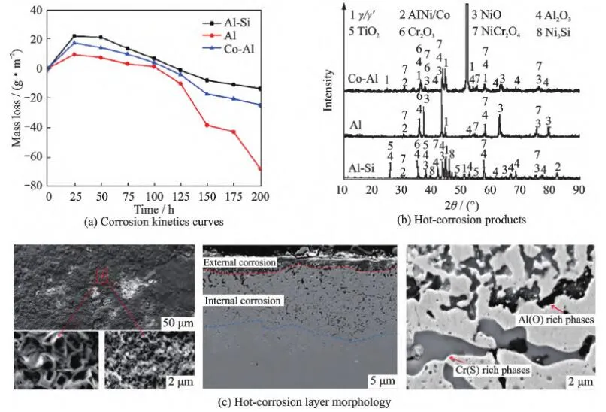
Do nhiệt độ cao (>800 ℃) mà lớp phủ bề mặt của cánh tuabin có thể chịu được trong quá trình vận hành, lớp phủ này thường phải chịu sự ăn mòn nhiệt ở nhiệt độ cao trong môi trường kết hợp giữa khí và môi trường biển. Các sản phẩm ăn mòn nhiệt cũng thay đổi tùy thuộc vào loại, thành phần và cấu trúc vi mô của lớp phủ. Đối với các lớp phủ kim loại, khả năng chống ăn mòn nhiệt của chúng có mối liên hệ chặt chẽ với sự hình thành một lớp oxit bảo vệ Al₂O₃ liên tục và dày đặc trên bề mặt lớp phủ. Li Yuchun [26] đã nghiên cứu hành vi ăn mòn nhiệt của hợp kim K488 và các lớp phủ nhôm thấm nhôm và nhôm thấm coban trên bề mặt của nó bằng phương pháp chôn muối. Kết quả cho thấy một hỗn hợp của Al₂O₃ và CoCr₂O₄ đã hình thành trên bề mặt lớp phủ nhôm thấm trong dung dịch muối nóng chảy 25% NaCl + 75% Na₂SO₄ ở 900 ℃. Sự hiện diện của oxit hỗn hợp đã cải thiện khả năng chống ăn mòn, trong khi lớp phủ nhôm thấm coban thể hiện khả năng chống ăn mòn nhiệt tuyệt vời do sự hình thành màng oxit bảo vệ Al₂O₃ dày đặc trên bề mặt. Li Yanming và cộng sự [27] đã chế tạo ba loại lớp phủ, Al Si, Al và Co Al, trên vật liệu thường được sử dụng là hợp kim nhiệt độ cao gốc niken DSM11 cho cánh tuabin khí. Họ đã nghiên cứu hiệu suất của ba loại lớp phủ này bằng cách phủ muối (tỷ lệ khối lượng 5% NaCl+95% Na₂SO₄) lên bề mặt các lớp phủ.
The hot corrosion performance at 900 ℃ is shown in Figure 2. The research results indicate that the kinetic curves of the three coatings are basically similar, all showing parabolic shapes. With the extension of corrosion time, the mass first increases and then decreases. The reason for the above quality changes is that in the early stage of the corrosion experiment (0-25 hours), the corrosion products are tightly bound to the coating and have less detachment; In the middle and later stages of corrosion, surface corrosion products fall off, and the exposed internal coating or substrate further undergoes thermal corrosion, resulting in a decrease in quality. After 200 hours of hot corrosion at 900 ℃, a continuous and dense oxide layer mainly composed of Al2O3 was formed on the surface corrosion zone of both Al Si coating and Co Al coating, which inhibited the progress of hot corrosion and had good thermal corrosion resistance; Unlike Al Si coating and Co Al coating, Al coating forms a mixed oxide layer on the surface corrosion zone, and the hot corrosion reaction continues, resulting in relatively poor thermal corrosion resistance. In addition, Liu Delin et al. [28] also confirmed the anti-oxidation and corrosion effects of NiCoCrAlYTa coating on DZ22B alloy and DZ22B alloy with NiCoCrAlYTa coating at 950 ℃ through hot corrosion tests. This is based on the formation of dense Al2O3 or Cr2O3 oxide films on the surface of the coating, which act as oxygen barrier layers (shielding layers) to prevent further oxidation or corrosion of the substrate.
Tương tự như các lớp phủ kim loại, khả năng chống ăn mòn nhiệt của lớp phủ rào cản nhiệt phần lớn phụ thuộc vào màng mỏng oxit Al₂O₃ hoặc Cr₂O₃ liên tục được hình thành trên bề mặt. Như Li Faguo và cộng sự [29] đã chỉ ra trong báo cáo tiến độ nghiên cứu gần đây của họ về khả năng chống ăn mòn trong môi trường khí quyển biển của các lớp phủ chịu nhiệt độ cao cho động cơ máy bay, hiệu quả chống ăn mòn nhiệt của YSZ chủ yếu đến từ Al₂O₃ có mật độ cao, trong đó Cr, Ta và Y có thể ổn định quá trình hình thành Al₂O₃ và cải thiện khả năng chống ăn mòn nhiệt của lớp phủ. Tuy nhiên, các nguyên tố ngoại lai như Na, V và S có thể gây ra sự hình thành YVO₄ trong nguyên tố Y, dẫn đến sự suy giảm chất lượng của lớp phủ YSZ. Khi muối nóng chảy Na₂SO₄ tồn tại một mình, nó không xảy ra phản ứng hóa học với YSZ. Cơ chế ăn mòn chủ yếu là do muối nóng chảy Na₂SO₄ bám vào các lỗ rỗng và vết nứt của YSZ, và ứng suất nhiệt do sự chênh lệch hệ số giãn nở trong các chu kỳ nóng-lạnh lặp đi lặp lại dẫn đến sự hỏng hóc của lớp phủ YSZ [20,21,2,23,24,25,26,27,28,30], khiến muối nóng chảy Na₂SO₄ thấm vào lớp liên kết qua TGO-YSZ, phản ứng với lớp liên kết và hình thành một lớp sunfua lỏng lẻo bên dưới lớp TGO. Có các vết nứt giữa lớp TGO và lớp sunfua [29], cuối cùng dẫn đến hiện tượng bong tróc lớp phủ. Khi có mặt muối nóng chảy V₂O₅, nó phản ứng với chất ổn định Y₂O₃ để tạo thành YVO₄, như được thể hiện trong phương trình (1). Sự phát triển của các nhánh YVO₄ tạo ra ứng suất lan truyền vết nứt [28,30,31]; Ngoài ra, YSZ trải qua quá trình chuyển đổi từ cấu trúc tinh thể tứ giác sang cấu trúc tinh thể đơn nghiêng, kèm theo sự giãn nở thể tích từ 3% sang 5%. Hiệu ứng kết hợp giữa ứng suất chuyển pha và ứng suất phát triển dẫn đến hiện tượng nứt hoặc thậm chí bong tróc lớp phủ.
- When Na2SO4 coexists with V2O5 to form NaVO3, as shown in equation (2), according to the Lewis acid base theory, compared to the acidity of V2O5, NaVO3 also has alkalinity. Therefore, compared to the corrosion process of pure V2O5, when Na2SO4 and V2O5 coexist, i.e. NaVO3 molten salt, the corrosion rate is faster, the YVO4 dendrite size is larger, and the YSZ thermal barrier coating fails faster.
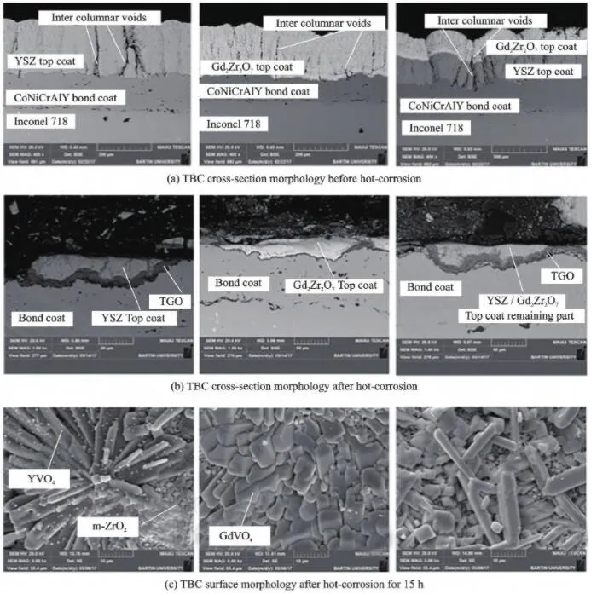
- In order to further improve the performance of thermal barrier coatings, scholars at home and abroad have studied and designed double-layer structure thermal barrier coatings, and evaluated their thermal corrosion resistance. The double-layer structure thermal barrier coating is mainly applied to new ceramic materials with poor mechanical properties. A YSZ coating is prepared between the bonding layer and the new material ceramic layer to reduce the difference in thermal expansion coefficient between layers and alleviate internal stress of the coating. Ozgurluk et al. [31] investigated the hot corrosion behavior of YSZ, Gd2Zr2O7, and YSZ/Gd2Zr2O7 thermal barrier coatings in molten sulfate and vanadate (55% V2O5+45% Na2SO4) at 1000 ℃, as shown in Figure 3. Research has found that high levels of V2O5 accelerate coating damage, and YSZ/Gd2Zr2O7 double-layer thermal barrier coatings exhibit better thermal corrosion resistance. The corrosion products in YSZ coating are monoclinic ZrO2 and YVO4, while in Gd2Zr2O7 and YSZ/Gd2Zr2O7 thermal barrier coatings, the corrosion products are monoclinic ZrO2 and GdVO4. The transformation of ZrO2 from tetragonal to monoclinic crystal structure causes damage to the coating, and the molten salt damages the columnar morphology of the coating, reducing its thermal insulation effect.
Hot corrosion mechanism of high-temperature alloys for turbine blades
When the coating of turbine blades peels off due to thermal corrosion and mechanical loads, the exposed high-temperature alloy substrate will further undergo thermal corrosion in gas and marine environments [32]. At present, aircraft engine turbine blades mainly include DD6, CMSX-4, CMSX-10, PWA1484 single crystal high-temperature alloy blades, while gas turbine turbine blades include single crystal, directionally solidified, and cast high-temperature alloy blades, such as IN-738, DZ125, K444, GTD-111, MD2, etc. [33].
In high-temperature corrosive environments, single crystal high-temperature alloys exhibit stronger resistance to thermal corrosion and lower average corrosion rates. The average hot corrosion rate of DD15 [34] single crystal high-temperature alloy in a high-temperature (900 ℃) corrosive environment mixed with fuel and seawater mist is 0.071 g/(m2 · h), and the corrosion layer does not peel off. Research on single crystal materials such as DD10 and DSM11 has shown [35] that after undergoing high-temperature hot corrosion, continuous layered protective oxide films of Cr2O3, TiO2, and Al2O3 will appear inside the corrosion products of single crystal high-temperature alloys. The corrosion products on the surface of these materials will provide good protection for the substrate, thereby hindering further hot corrosion and improving the thermal corrosion resistance of single crystal materials. In low-temperature hot corrosion environments, Luthra [36] found that Na2SO4 coated on the surface of cobalt based high-temperature alloys is solid, and sufficient SO3 partial pressure in the atmosphere can sulfide NiO to form NiSO4. This compound will react with excess Na2SO4 to form liquid eutectic salts. The molten mixed sulfate salt dissolves the protective oxide layer and rapidly transports the reactants through the liquid in the corrosion pit, increasing the corrosion rate. In nickel based alloys, the sulfation of NiO is relatively less. Lortrakul et al. [37] found that after coating Na2SO4 on the surface of CMSX-4 and heating it to 700 ℃ in an O2-SO2-SO3 atmosphere, XRD analysis showed that NiSO4 had disappeared after 5 hours of corrosion, indicating that low melting eutectic salts could no longer form. However, after 50 hours, obvious sulfide enrichment zones were observed near the external/internal corrosion layer interface and the internal corrosion layer/substrate interface, indicating that the essence of low-temperature hot corrosion is still the sulfide oxidation in the local melting zone, similar to the mechanism of high-temperature hot corrosion.
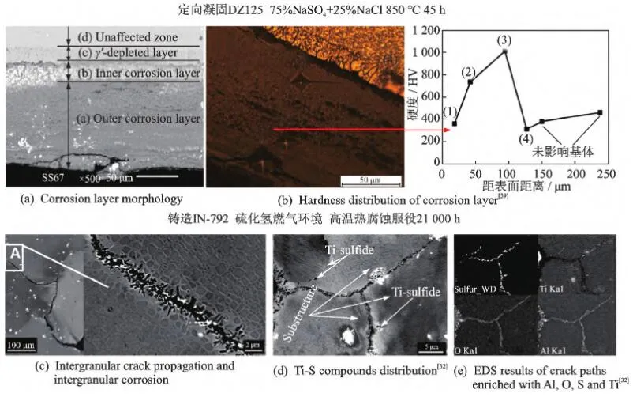
Compared to single crystal high-temperature alloy blades, directional solidification high-temperature alloys have a small amount of grain boundaries, which can cause a decrease in the alloy’s resistance to thermal corrosion. Kumawat et al. [38] evaluated the hot corrosion behavior of directionally solidified CM247LC alloy at 950 ℃ with different salt deposition amounts. Compared with pure oxidation in air, it was found that the alloy underwent accelerated corrosion degradation in a molten salt environment. Within the first 0.5 hours of exposure, the alloy reacted with oxygen elements in the molten salt to form oxides of Al and Cr, exhibiting a lower corrosion rate. Afterwards, with the increase of oxygen flux, the corrosion acceleration stage is entered, and the corrosion mechanism shifts from alkaline corrosion mechanism to acidic corrosion mechanism. Due to the infiltration of sulfur, the hot corrosion behavior can continue continuously. Yang et al. [39] conducted a study on high-temperature hot corrosion of directionally solidified DZ125 alloy at 850 ℃. The corrosion layer of the alloy is divided into two layers: the outer layer is a porous layer of oxide NiO/Cr2O3/Al2O3, while the inner layer is a uniform oxide mainly composed of Cr2O3, as shown in Figure 4. High temperature hot corrosion not only exacerbates the formation of surface oxides in directionally solidified alloys, but also leads to the formation of low strength γ ‘poor zones on the subsurface, as shown in Figure 4 (b). This is also one of the main reasons for the degradation of mechanical properties of alloys caused by high-temperature hot corrosion.
Compared to single crystal and directionally solidified high-temperature alloys, cast high-temperature alloys have more grain boundaries, and elements forming oxides and sulfides can rapidly diffuse along the grain boundaries, accelerating hot corrosion and oxidation [40]. When casting high-temperature alloys, sulfur elements diffuse along grain boundaries during long-term corrosion processes, causing intergranular brittleness that has a significant impact on their service performance. As shown in Figure 4 (d, e), IN-792 cast high-temperature alloy blades [32] exhibited mechanical and chemical damage after approximately 21000 hours of service. Among them, high-temperature hot corrosion leads to the presence of Ti sulfides and free forms of sulfur elements at grain boundaries, resulting in intergranular embrittlement and reduced resistance to crack propagation. The investigation found that almost all cracks on the IN-792 turbine blades propagate in a transgranular manner. Under the high-temperature hot corrosion of casting high-temperature alloy K35 [41] containing NaCl mixed salt, the originally dense Cr2O3 oxide layer becomes loose, providing a fast channel for the diffusion of oxygen and sulfur.
 Vietnamese
  English
  Arabic
  Moroccan Arabic
  Dutch
Dutch  French
  German
  Italian
  Polish
  Portuguese
  Russian
  Spanish
  Turkish
  Azerbaijani
  Indonesian
  Thai
Thai  Japanese
  Korean
  Malay
Malay  Myanmar
  Serbian
  Swedish